Categories
NCS News

Driving Innovation through Collaboration

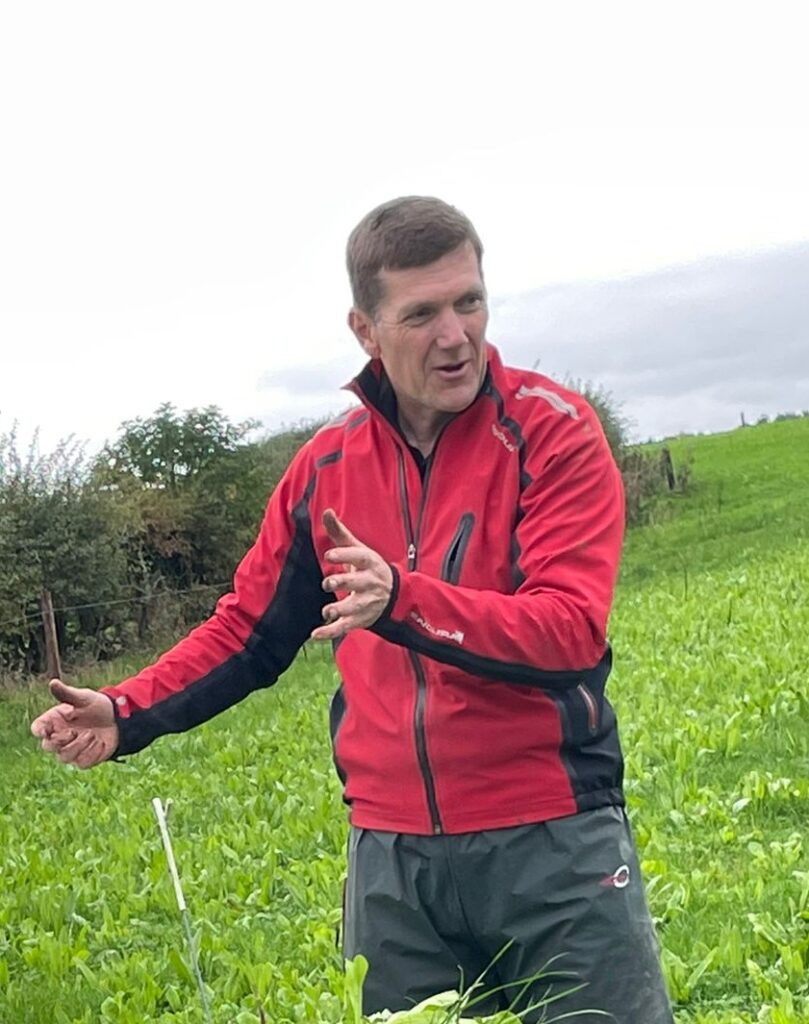
Three mantras guide Paul Barnes’s approach to farming. The first two were inspired by his grandfather: “Look after the soil and it’ll look after you” and “Learn something new every day”. The third is a quote from Charles Darwin: “It’s not the most intelligent of the species that will survive – it’s the one that’s most adaptable to change”.

These principles reflect Paul’s commitment to sustainable farming practices and continuous improvement through on-farm trials and working with other farmers. He says: “Being part of PulsePEP is a fantastic opportunity, because generally as farmers we don’t do enough collaboration and talking.”

Meeting other farmers and experts, and hosting farm visits is always fruitful, he continues. “You can always take something home about how to take things forward and improve your system.”

The 1240ha South Ormsby Estate was purchased by new owners in 2016. Paul joined a year later and set about converting the in-hand farming operations to organic production. As well as field beans, he also produces vining peas as part of a local growers’ group. He firmly believes in the value of pulses in the rotation for an organic system – not just for the crop itself but what it provides the following crop.

“We are looking to achieve quality rather than quantity,” he explains. For example his spring wheat crops following spring beans are destined for premium, locally-produced wholemeal flour through a collaboration with a local miller.

In 2023-4 Paul conducted three different NCS project trials exploring the effect of the biostimulants Vixeran and Utrisha on his bean crops. He is continuing the Vixeran trial in another field in 2024-5 while also looking at the effect of the treated and untreated 2024 beans on the subsequent spring wheat (for milling).

While other growers had positive experiences with their 2024 spring beans, Paul unfortunately did not, although the crop had been looking promising. “The drilling conditions were ideal, we used 55 seeds/m2, did two passes with a weed harrow and it was clean as a whistle.

“But an onslaught of chocolate spot just annihilated it,” he says. Yields were down to just 1.6t/ha in places.

Like all Pulse Pioneers, Paul’s trials are monitored and benchmarked through the Bean YEN. As well as leaf and tissue samples it involved looking below the ground too, to explore nodulation and how the treatments affected it. Paul was given a score by project researchers which revealed that the treated plots achieved higher levels of nodulation.

“Hopefully we will now see the impact of this nitrogen fixation. We will be able to get out there and through our soil sampling monitor it through into the following crop.”

Despite the disease challenges, Paul remains positive about pulses, their role in the rotation and their potential for South Ormsby and other farms. However, growers need to work together to share learning and knowledge to overcome the difficulties, he says. This is particularly pertinent for the 23 Pulse Pioneers who should share learning from their on-farm trials.

“We need to generate more knowledge, and share more,” he concludes. “Collaboration is a fantastic thing. Let’s get more on board – bring it on.”
Categories
NCS News

Building Resilience in the Farming System

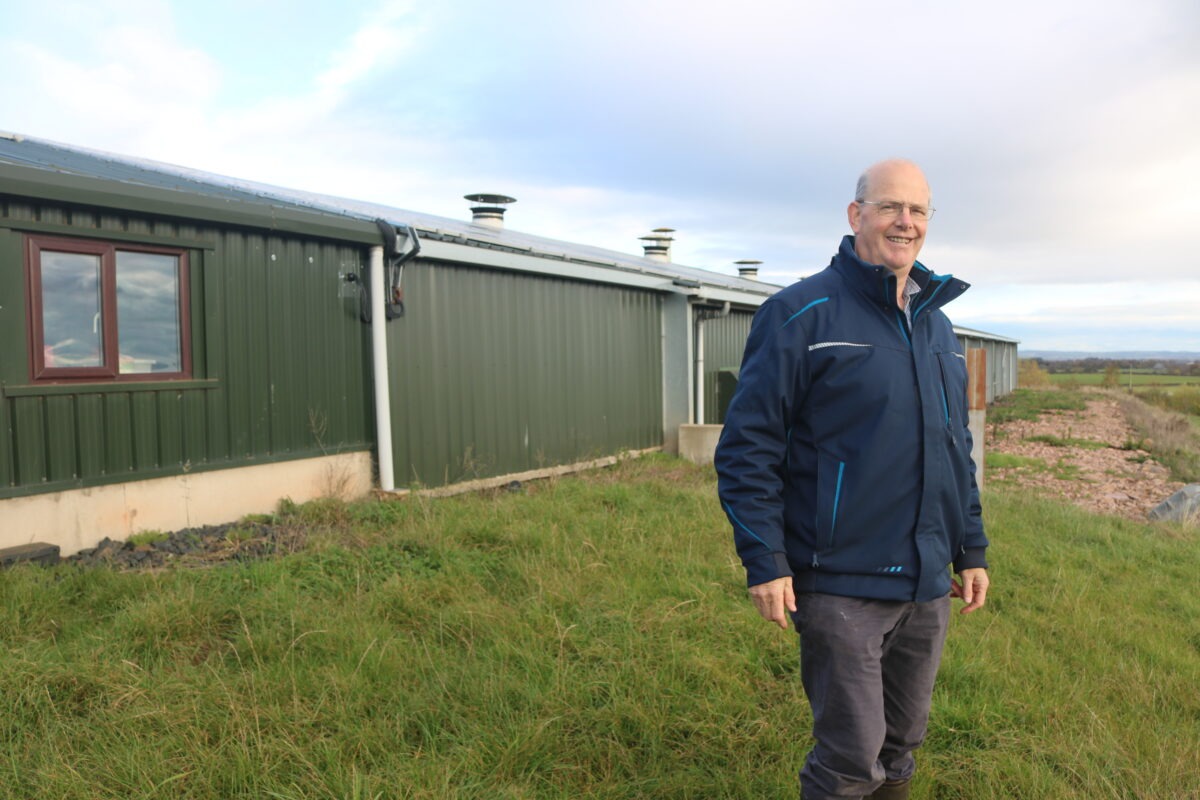
By taking part in carbon assessments on his farm John Seed has been able to identify areas for improvement and instigate a raft of changes to improve the business’s sustainability.

Energy, fertiliser and imported feed for his laying hens were identified as the main sources of carbon emissions. So as well as installing solar panels, a biomass boiler and wind turbine, he has made changes to management practices and started growing faba beans to replace a proportion of the soya fed to his free-range hens.

As well as beans John grows oats for Quaker, winter wheat for milling and spring barley for malting on the farm near Duns. Improving biodiversity is a focus and he has 16% of the farm in margins, beetle banks and other environmentally friendly areas. In recent years he has moved away from ploughing to a direct drilling approach, an investment which he says has paid off.

John says: “We’re now at net zero on our arable unit based on growing beans, doing minimum tillage, having green cover crops and margins, doing all the things that we do.”

He continues to experiment to find ways to make further improvements across the farm including Bokashi fermentation – mixing poultry manure, chopped straw, woodchip and acti-ferm in an ag bag – to create compost which he hopes will reduce ammonia emissions from the poultry unit in the process.

The changes to reduce dependency on soya were initially prompted by rising feed costs.

“We started feeding our own grain to the hens when the egg price was below the cost of production, and we had to find ways to do it better. We discovered that 82% of the carbon emissions from the poultry unit came from purchased feed, and particularly from soya, so we set about trying to reduce that.”

An SAC report promoting home-grown proteins gave him a further nudge to start growing beans to supplement the diet of his 32,000 hens. Several years on and he has honed his system to make better use of the crop. The level of beans starts at 5% when the hens first arrive at 16 weeks of age, and increases to 18% as they mature.

“We are still buying soya, but feeding beans even at 10% reduces our carbon emissions by about 400t a year, just from that simple thing alone,” he says. “I’m excited about the ability to dehull and process beans too.”

His interest in beans led him to join the NCS project as a Pulse Pioneer, and he has since become a great advocate for taking part in funded research.

“We need that support because of the risks involved. For example if you’ve got a shed of hens and you feed them too many beans the methionine levels drop and they start feather pecking. They go off the lay and it costs you a fortune. It’s heartbreaking.

“You need to have government sponsored proper research so we can try new approaches. The NCS project has been a joy for me, and I’m pleased to be part of it.”

Like the other Pulse Pioneers John’s trials focus on the agronomy of growing beans and subsequent crops. In the first year (2023-4) he looked at the impact of over sowing both spring beans and oats with clover in Garden Park Field. In year two the same field has been planted with winter wheat and he is assessing the impact of last year’s clover and beans on the wheat.

He has also brought in a second field – Broomhill Field – planted with winter beans and a spring oats comparison where he is looking at the effects of soil phosphate activator Agrii-Start Release.

“The clover undersowing worked well in the spring oats, improving soil structure and moisture retention, but it wasn’t successful in the beans, so we won’t be repeating it there. Learning from this, we’re refining our approach to maximise benefits where they work best,” says John.

“The new trial with Agrii-Start should help us make better use of our poultry manure by improving phosphate availability and nutrient cycling.

“Certainly, the NCS project has provided a valuable platform to let us explore these challenges while minimising risk to us and contributing to a more sustainable supply chain. This is all part of our efforts to build resilience in our farming system.”

It is all fuelled by a drive to make the business more profitable and more sustainable which he would like to see recognised by retailers. “We are reducing our carbon footprint by over 400 tonnes a year. We are sequestering carbon and we’re rebuilding biodiversity. The reality is that the retailers demand sustainability, but we don’t get paid for it.”

Action from the government to support and demand change, namely a policy for the inclusion of home-grown protein in livestock feed, is also urgently needed, says John.

“We need the market conditions and policies to make changes. It can happen quickly if the signals are clear. We want policies that reward sustainability, and we want markets that value farmers’ efforts.

“It’s not hard and yet, it appears to me, the policy makers and the retailers are able to find reasons not to deliver it.”

Categories
NCS News

Farmers at the Forefront of Innovation

The NCS scientists and researchers bring an unprecedented level of expertise to the project, but there’s no replacement for on-farm trials to show farmers what can be done.

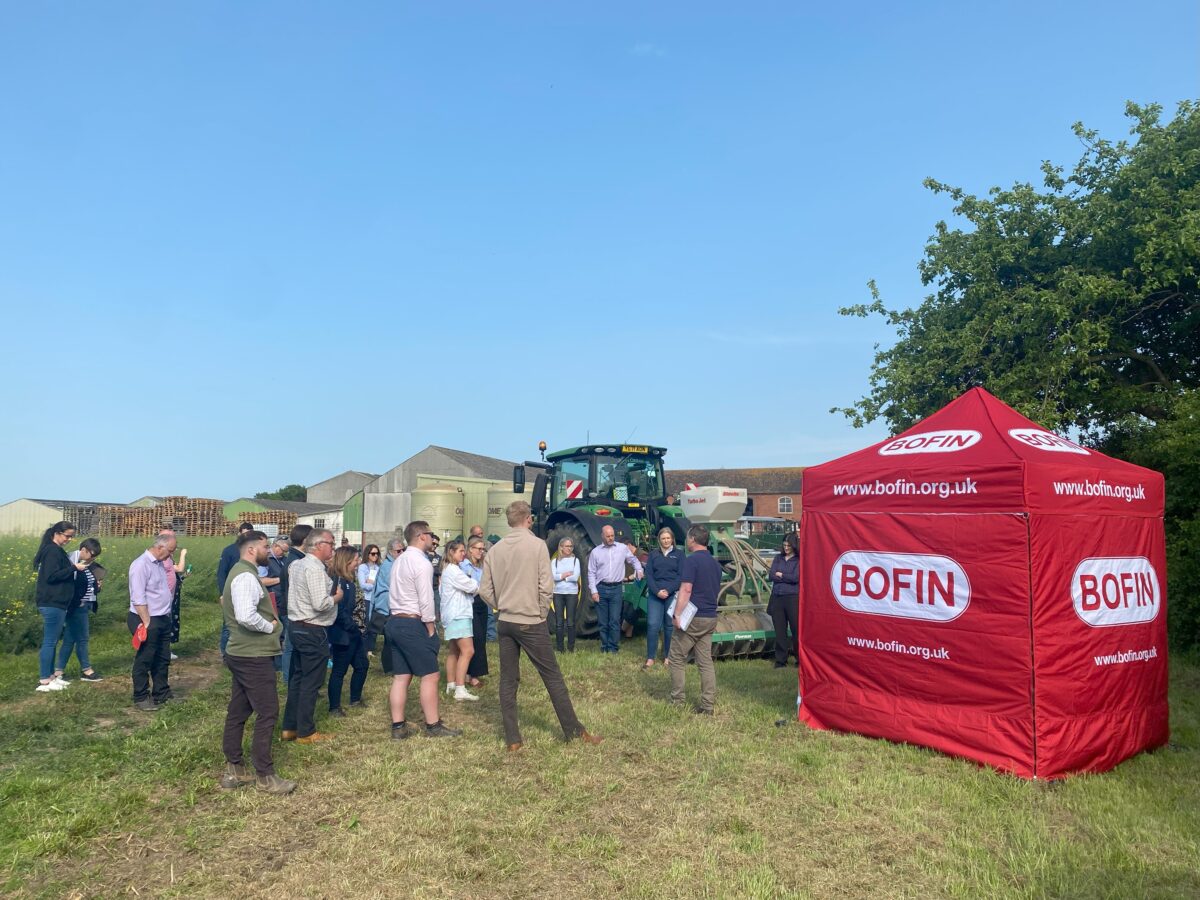
On-farm trials within the project are designed to explore the potential of pulse crops in reducing carbon emissions and improving soil health. To enable this the British On-Farm Innovation Network (BOFIN) recruited 10 farmers growing beans in the 2023-4 season and a further 10 for 2024-5.

With support from BOFIN the Pulse Pioneers each devise trials to compare the effects of their bean crops on soil health and subsequent crops. This rotational platform approach allows for comprehensive monitoring of the benefits of pulse crops throughout the rotation cycle.

“The Pulse Pioneers’ trials ensure that farmers are at the forefront of the NCS project and that the benefits that accrue from a switch into home-grown pulses are delivered primarily on farm, into a farmer’s pocket and the long-term sustainability of their business,” says Tom Allen-Stevens, BOFIN managing director.

The rotational platform allows the Pioneers to gather knowledge and data on the difference the pulse crop makes within their cropping systems. “In addition, all farmers are trialling practices and innovations to improve profitability and consistency of returns from the crop, whether that’s the effect of sulphur fertiliser, novel biostimulants or bi-cropping,” he adds.

There are some core benefits this approach brings for all farmers, deeply entrenched in what BOFIN aims to deliver across its Defra-funded projects, now involving 70 BOFIN member farmers in on-farm trials:

Real-world application: On-farm trials bring scientific innovation directly onto working farms, ensuring that research is practical and applicable.

Farmer-led research: Having farmers at the centre of the research process ensures that the trials address real agricultural needs and challenges.

Data collection: Farmers have proven capable of delivering scientifically valid data, adding significant value to the project’s progress.

Knowledge sharing: Pulse Pioneers are also required to act as ‘project ambassadors’ and share their findings and observations within and outside the project.

The farmers are engaged under contract to BOFIN and there are key aspects they have to deliver:

The in-field trials: a pea or bean field in which anarea is not growing a pulse crop (eg spring oats) that then comes back into the same crop as the rest of the field in the following year. An additional product/practice should be trialled across at least two tramlines.

Field and crop-monitoring data: This is managed through ADAS YEN (Yield Enhancement Network) with growers prompted to take soil, leaf and grain samples at key timings for analysis, along with field and plot yield-data.

Carbon footprint: Growers must complete an annual assessment of their business through the Farm Carbon Toolkit.

Project ambassador: Through PulsePEP, they publish details of the trial and their farming system, and join the discussion in the forum area, hosted by The Farming Forum. This activity, along with attendance at events and workshops accrue points with a target minimum total.

This brings them some key outputs, useful not just to their own system, but for all pulse growers looking to improve returns:

ADAS YEN report: More than 50 key parameters about their crop, benchmarked against other growers in the Pea or Bean YEN, for both their treated and untreated crop areas.

Soil mineral nitrogen analysis: N-Min data before and after the pulse crop to assess the nitrogen available to the following crop and the contribution made by the pulse crop.

Leaf sample analyses: Data through the year to help understand nutrient uptake by the crop.

Grain sample analyses: Data on both nutrient and nutritional content to understand nutrient uptake as well as the crop value as a livestock feed.

Farm Carbon Toolkit report: How the pulse crop influences the farm’s carbon emissions.

Throughout their involvement, BOFIN keeps the Pulse Pioneers in dialogue with the scientists engaged on the project to help both farmers and scientists progress farm practice, notes Tom.

“The industry has an understandable focus on ‘What Works’ to improve crop productivity. We aim to deliver the ‘So What’ – our farmers are gathering a valuable pool of data on their crop. We’re developing the tools to help them assess what it means to help them make better, data-informed decisions on how to improve their crop, the consistency of returns, and the value of pulses in the rotation.”

Categories
NCS News

Opportunities for paid on-farm trials

A major project aiming to cut agriculture’s carbon footprint through increased inclusion of pulses in arable systems and livestock diets is looking for more farmers to participate in paid on-farm trials.

Now in its third year, the NCS (Nitrogen Climate Smart) project is led by PGRO alongside a consortium of 16 other organisations. Roger Vickers, CEO of PGRO and NCS project lead said: “We are now moving towards looking at the legacy effects of the trials – comparing the effect of previous pulse crops on subsequent crops as well as different treatments designed to optimise production and reduce carbon emissions.

“Together we are exploring all aspects of the production of beans from agronomy to harvest through to processing and use in livestock feed.”

The project’s ambition is to show the benefits of increasing pulse production in arable rotations to 20% which could replace around 50% of the imported soya currently consumed by UK livestock. This in turn could lead to carbon savings of around 3.4Mt CO2 equivalent.

John McArthur, of partner organisation McArthur BDC explained that this was equal a 7% reduction in UK agriculture’s emissions. “This one intervention would make a huge difference to both the arable and livestock sectors and is something that with continued progress we believe can be achieved,” he said.

John McArthur

Part of the project led by McArthur BDC is exploring the effect of dehulling and thermal treatment on the nutritive value of beans to increase the soya substitution potential of faba beans, he explained. Other partner organisations are looking at the production side aiming to increase knowledge of understanding of pulse crops, explained Dr Thomas Wilkinson of ADAS.

This includes trials by partner organisations and the Pulse Pioneer farmers which all lookat maximising pulse crops and getting the best from them. “We are now moving towards looking at the legacy effects of the trials – comparing the effect of previous pulse crops on subsequent crops as well as different treatments designed to optimise production.” ADAS is also combining these findings with data from the Pulse Yield Enhancement Network (YEN).

“At the moment many growers don’t seem to be reducing nitrogen rates after pulse crops,” said Dr Wilkinson. “We want to have a deeper understanding of residual nitrogen so that we know how growers could modify nitrogen rates, which would have a significant impact on their carbon footprint.”

Tom Allen-Stevens of the British On-Farm Innovation Network (BOFIN) which recruits and supports the farmer triallists explained that more Pulse Pioneers were needed for the 2025-26 trials. “We currently have 23 farmer trialists on this project and need to increase that to 40 for the upcoming year,” he said. “We are looking for farmers who are at the top of their game and keen to know how they can grow beans better and share that knowledge with other farmers. 

“As with all BOFIN projects our farmer trialists are paid for their role in the project and also gain from collaborating with other farmers, scientists and industry experts.

“Pulses promise huge opportunities for UK agriculture, and our Pulse Pioneers are driving that.”

Another aspect of the project is improving links with the supply chain, he said. “As a direct result of this project, and particularly our conference in January 2025, we are in discussion with processors and manufacturers keen to have better surety of supply. We hope that the setting up of grower groups will be another great outcome from this project.” 

Other partner organisations include Farm Carbon Toolkit who were supporting farmers to carbon footprint their businesses to quantify the changes brought about by increased pulse production. The Andersons Centre is also carrying out Cost Benefit Analyses of pulse production over the life of the project.

Categories
NCS News

Partner report:

Agricultural emissions could potentially be reduced by 3.4Mt CO2e by replacing half of soyabean meal in livestock feed with homegrown pulses as a result of reduced deforestation and land use change, lower synthetic fertiliser use and fuel savings.

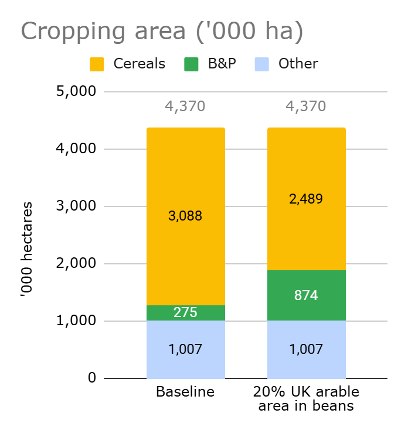
In 2023, only 6.3% of the UK’s 4.3 million hectares of cropping land grew beans or pulses. These crops have significant agricultural potential; offering soil health benefits, livestock feed options, and alternatives to currently stressed rotations. The NCS project hopes to harness this potential by expanding the pulse cropping to 20% of the total arable area in the UK. This would involve increasing the annual area of beans and pulses grown from 275,090 ha’s (6.3%) to 874,026 ha’s (20%).

The impact of expanding pulse cropping

Expanding the pulse cropping area will result in GHG emissions reductions in the areas highlighted below:

  • Reduced fuel usage
  • Direct fertiliser avoidance
  • Indirect fertiliser avoidance as a result of leguminous residues
  • Providing a low emission feed alternative to imported soya
Reducing fuel usage

Growing and harvesting pulses requires less fuel than growing cereal crops. FCT modelling on the operations needed to grow cereals indicates that 91 litres of diesel/ha is required, compared to 84 litres/ha to grow beans and pulses. This reduces emissions by 13,166.79 tCO2e when scaled out across the UK arable area.

Reducing fertiliser reliance

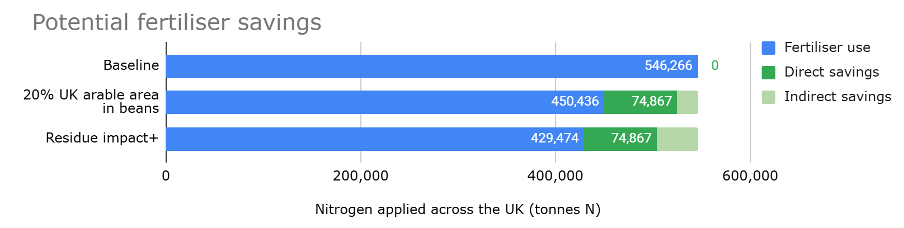
Growing pulses like peas and beans reduces reliance on synthetic nitrogen fertilisers both during the pulses cropping year and for subsequent crops, as these plants fix nitrogen into the soil. In 2023, the UK applied an average of 125 kg N/ha of fertiliser, totalling 546,266 tonnes and emitting 3.6 MT CO2e. By expanding pulse cultivation, the UK could save 74,867 tonnes of nitrogen fertiliser annually, directly avoiding 494,925 tCO2e emissions. Moreover, pulse residues can enhance nitrogen availability for subsequent crops, amounting to 35–70 kgN/ha (depending on soil conditions etc.). This could save an additional 20,963–41,926 tonnes of nitrogen annually across the UK, equating to 138,580-277,160 tCO2e.

Substitution of imported soya feed

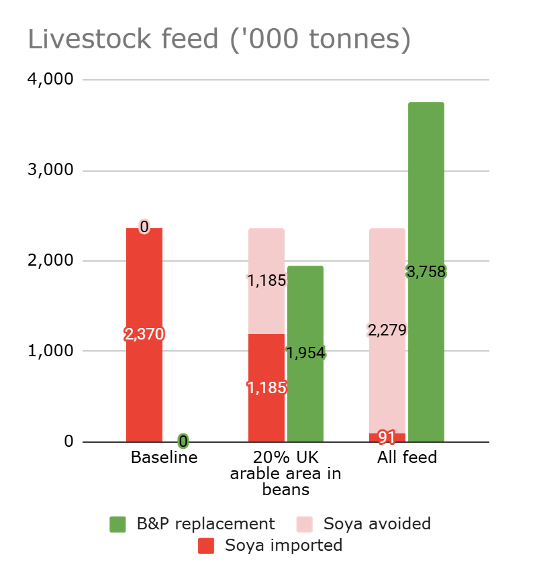
In 2023, the UK imported 2.37 million tonnes of soya feed, 74% from South America, resulting in 7.3 MT CO2e emissions. UK grown beans could replace some of this soya, substantially reducing the footprint of animal feed. If all UK-grown beans within the scenario proposed by NCS were used within compound feeds and straights, they could replace 96% of soya imports, avoiding 5.3 MT CO2e.  

A more realistic scenario is replacing 50% of imported soya with 1.95 million tonnes of UK beans, requiring 454,468 hectares (52% of beans/peas cropping area). This would cut feed emissions to 4.5 MT CO2e, saving 2.8 MT CO2e compared to current levels of soya imports.

Conclusion

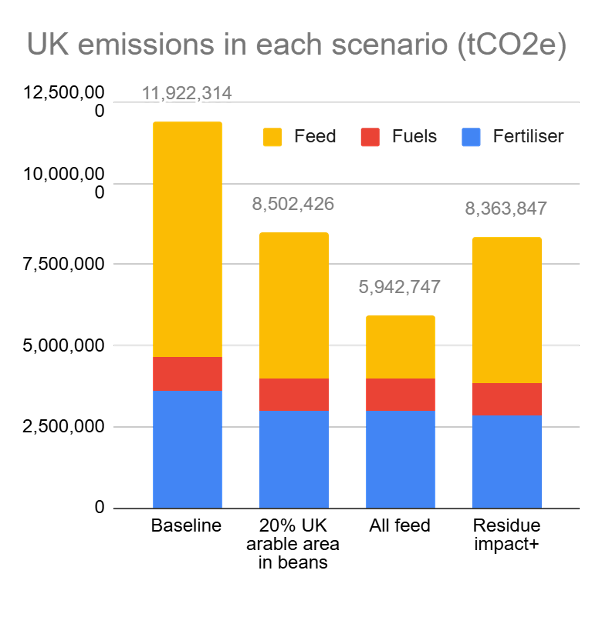
The expansion of beans and pulses to cover 20% of the UK cropping area could save 3.4 MT CO2e (equivalent to 7% of UK agriculture’s total emissions). This would increase if more of the beans and pulses grown could displace imported soyabean meal.

Sources:
  • Fertiliser data from the British survey of Fertiliser practice 2023
  • Land use data from DEFRA land use and crop areas 2023
  • Fuel usage based on FCT modelling of the field operations
  • Soya imports from EFECA and UK soya manifesto 2024 progress report
  • Protein content: Johnston et al 2019 https://doi.org/10.1016/j.livsci.2018.12.015
Categories
NCS News

From Soya to Sustainability:

Solutions presented at From Soya to Sustainability in Peterborough on Wednesday 22nd January included presentation of research carried out by SRUC, The James Hutton Institute and Agrii and the experience of farmers involved in the project.

Lee Truelove, Head of Regenerative Farming at First Milk said the cooperative was working to support the supply chain to find a ‘route out of soya’.

“Is certified deforestation-free soya the end game? I suggest it isn’t,” he said. “Even if that soy is certified questions still exist about how it’s grown. 

“We also need to think about ghost acres. It’s all very well being efficient on the farm, but that can be undermined by how many acres somewhere else in the world are needed to supply feed for the cows.”

The alternative was obvious, he said. “We’re talking about UK-grown proteins including beans, and we definitely support that at First Milk.” Feeding trials by First Milk producers had been positive and would be repeated this winter, he said. 

“We’re going to expand it, but we do think the potential is there. As a dairy cooperative, we’re looking to help the supply chain because we do think there is a route out of soya.”   

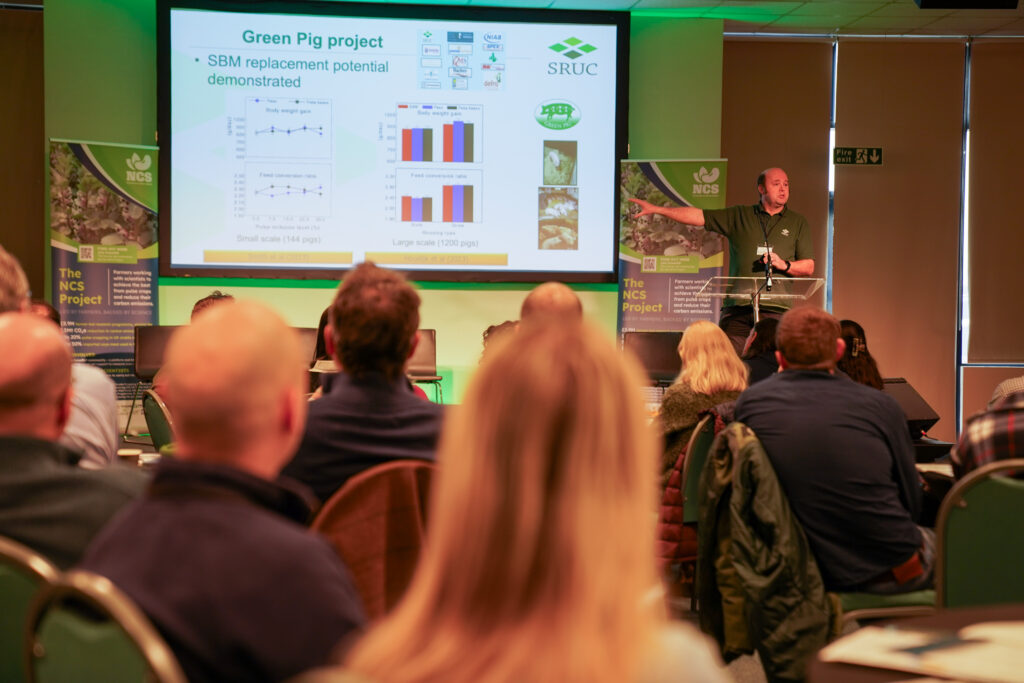
Jos Houdijk of SRUC said that faba beans were also viable as an alternative to soya for growing pigs and chickens, but processing made them better. 

“If we dehull faba beans we lift the digestibility and the concentration of amino acids, and that gives us opportunity to increase soya replacement potential.” 

An NCS trial using the bean variety Lynx, combined with dehulling and toasting, found that broilers (meat chickens) fed this variety up to 30% reached the same finished weights as those fed on soya, but with an improved feed conversion ratio. 

“We produced these chickens with 68% less soya bean meal input and the carbon footprint saving was almost 40%,” he said. 

Arable and poultry producer John Seed said he started looking to replace soya when the egg price was below the cost of production, but soon also saw the environmental cost. “Eighty-two per cent of the carbon emissions from my farm came from purchased feed and the soya predominantly.”

He praised the NCS Project, in which he is involved as a Pulse Pioneer, paid to carry out on-farm trials. Trialling new approaches can be both expensive and ‘heartbreaking’ he said. “You need to have government sponsored research like this.”

He found that by feeding beans, even at 10% he reduced emissions by about 400t/year. 

Farmers shouldn’t be taking sole responsibility, he concluded. “We are the front line but we are dealing with the broken promises, the sudden loss of subsidy and trade deals favouring unsustainable imports.” 

Read more: The potential for pulses in the arable rotation

Categories
NCS News

From Soya to Sustainability:

Revised figures reveal the full extent of the savings that would be made possible that increasing pulse production and displacing imported soya could bring.

Increasing production of pulse crops and reducing the amount of imported soya bean meal fed to livestock, could drastically reduce the UK’s agricultural carbon footprint, bringing a raft of other social and environmental benefits too.

New data presented at ‘From Soya to Sustainability’ in Peterborough on Wednesday 22nd January showed 3.4Mt of CO2 equivalent could be saved which would cut the agricultural industry’s footprint by 7%.

The revised figures, from a study by Farm Carbon Toolkit, suggest the potential to cut carbon emissions through better use of home-grown pulses is more than 2.5 times previous estimates.

The reduction can be achieved by increasing pulse production to 20% of the current total cropped area and replacing 50% of the imported soya bean meal currently being fed to livestock, explained John McArthur, managing director of McArthur BDC. Showing what can be achieved by this shift are the twin aims of the NCS Project – a four-year, £5.9 million project funded by DEFRA’s Farming Futures R&D Fund.

“That saving is driven by four main factors – fuel use, synthetic nitrogen fertiliser use, both directly and indirectly, and swapping imported soya bean meal to UK pulses,” he said. 

The 17 partner organisations in the project had initially set out to show its twin aims would achieve a net target carbon reduction of 1.5Mt. But data processed since the project began in April 2023 have revealed the potential gains that can be made from a move away from imported soya to UK grown beans are far greater than previously estimated.

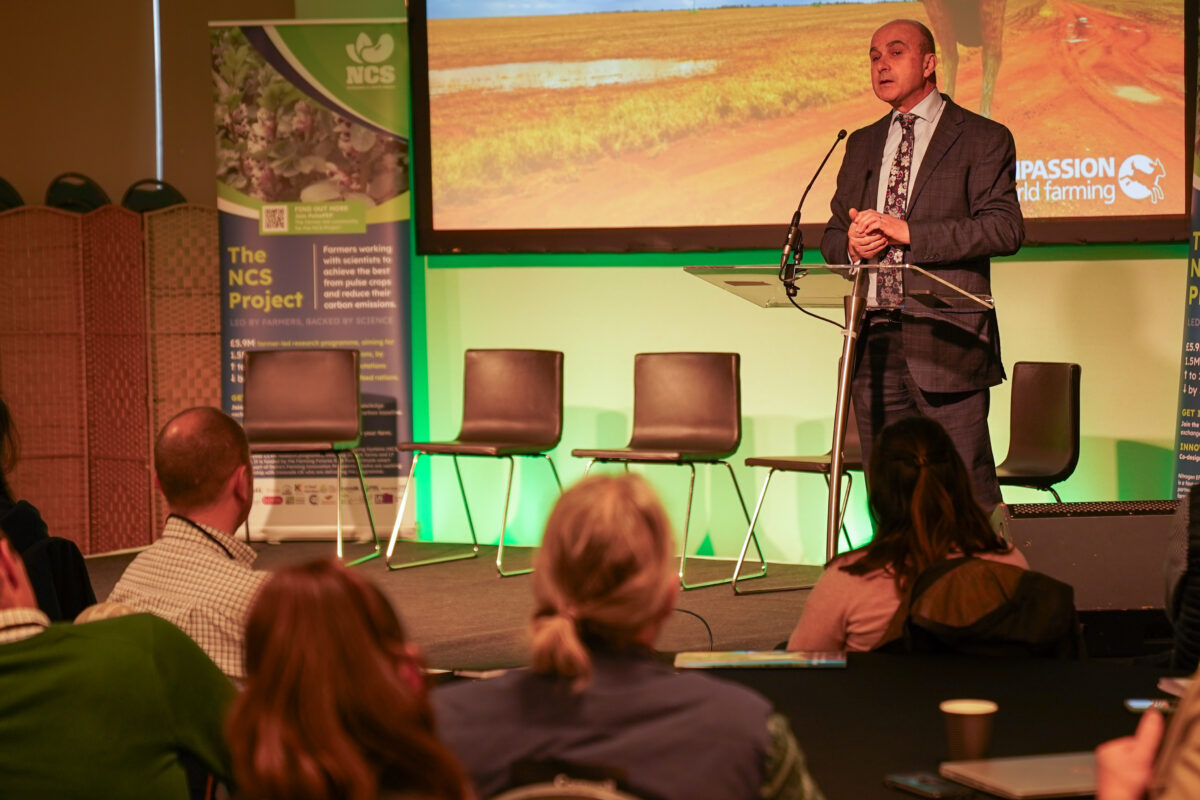
Philip Lymbery, Global CEO of Compassion in World Farming International spoke about the need for farmers to be part of the solution to climate change: “There needs to be a change, but don’t pile it on farmers and farming to find a way out and to fund it. We as a society need to get behind the farming community, to get behind the leaders that are bringing together the innovators, and make it happen. Enable them and bring public money forward.”

Philip Lymbery, Global CEO, Compassion in World Farming International

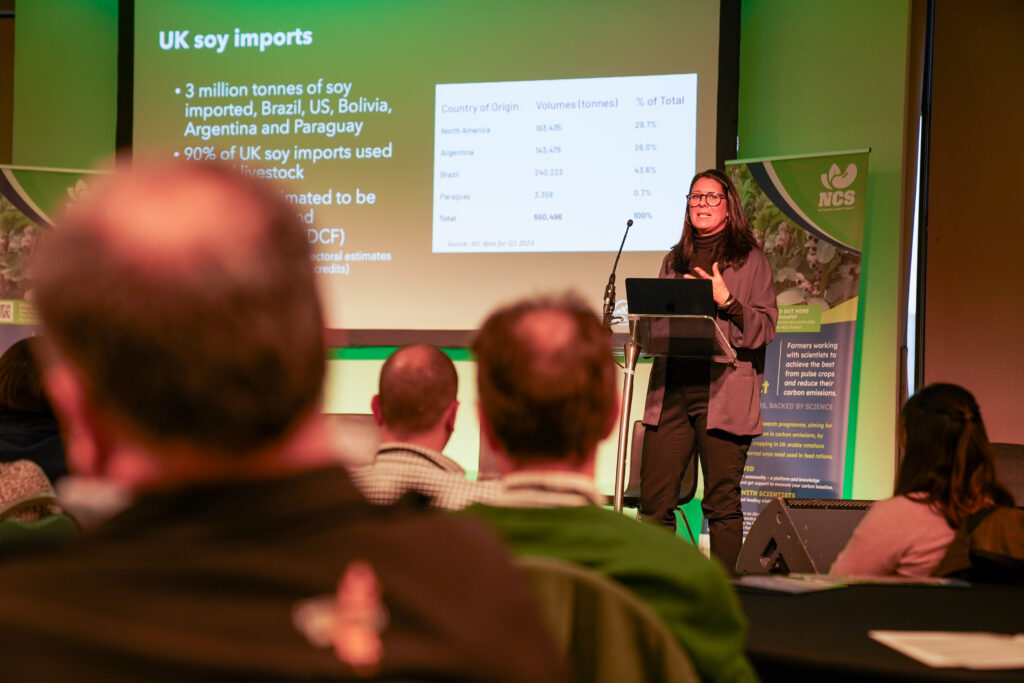
Gemma Hoskins, UK Director of Mighty Earth highlighted the link between imported soya and deforestation in Latin America. Estimates of deforestation and conversion-free soy volumes quoted by traders  like Cargill, use “maths jiggery pokery” with little publictransparency of the data used to calculate their claims, she said. EU deforestation legislation coming into force on 30th December 2025 would cover a range of commodities and covered both illegal and legal deforestation, she said, whereas the delayed UK legislation fell short by only covering illegal deforestation

“To confirm if you have legal or illegal deforestation within your supply chain, you require farm-level traceability data from your soy exporters.”

Gemma Hoskins, UK Director, Mighty Earth

Certification has been designed to signal market demand for deforestation-free soya, but traceability was an issue here too, she warned. “The credibility of certificates and the ability to drive a ‘clean supplier’ approach has been really limited within the soya supply sector.

“What we want to see now is farmers and the feed companies at the heart of this conversation and to empower them to put pressure on traders for deforestation and conversion-free soy.”

Read more: A route out of soya for livestock

Categories
NCS News

From Soya to Sustainability:

The UK food system’s ‘addiction’ to imported soybean meal is a major contributor to current carbon emissions and a threat to sustainability therefore urgent action is needed. 

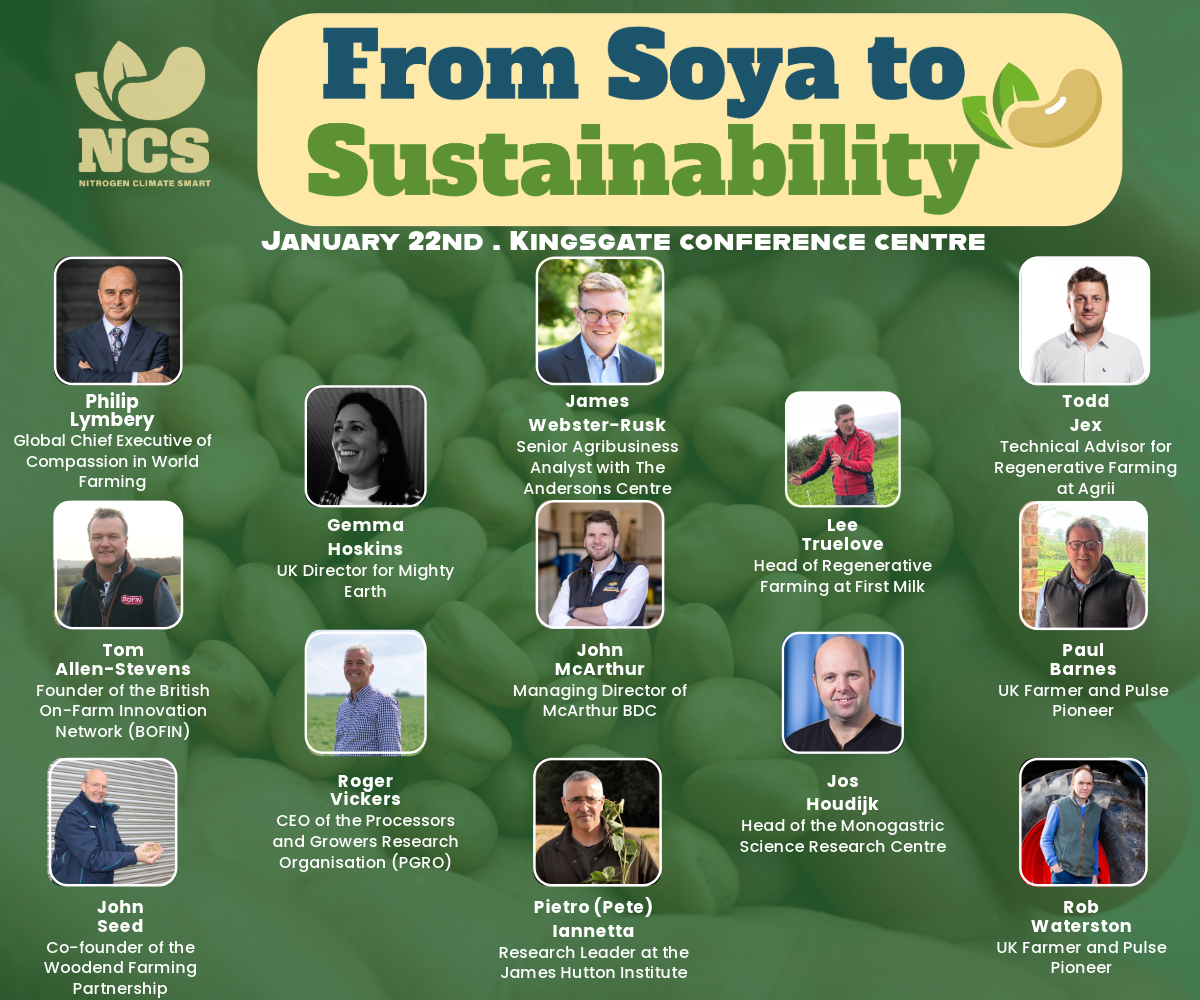
Speakers at the From Soya to Sustainability conference in Peterborough on Wednesday 22nd January will inform and inspire delegates from across the agricultural supply chain on the need for change, with a focus on solutions and collective action.

Headline speaker Philip Lymbery will emphasise the urgent need for change in our food systems. Philip is Global Chief Executive of Compassion in World Farming and author of Sixty Harvests Left: How to Reach a Nature-Friendly Future.

Gemma Hoskins, UK Director for Mighty Earth will stress the importance of robust regulations if British businesses are to eradicate illegal deforestation in soy supply chains. Her recent report Foul Play linked Brazilian soy to UK animal feed, and with recent figures suggesting an increase in deforestation in Brazil, the need to address this has never been more pertinent. 

Gemma Hoskins, Mighty Earth

Other speakers include scientists and experts from the NCS Project (Nitrogen Efficient Plants for Climate Smart Arable Cropping Systems) who believe that reducing our food system’s dependency on imported soya lies in increased production and use of peas and beans. The line-up includes Pete Ianetta (The James Hutton Institute), Jos Houdjik (SRUC), John McArthur (McArthur BDC), Tom Allen-Stevens (British On-Farm Innovation Network) and Lee Truelove (First Milk). Agrii agronomist Todd Jex will share his expertise on the benefits of beans and his secrets to pulse crops that perform consistently well. James Webster-Rusk of The Andersons Centre will share outcomes from the NCS Project’s first Cost-Benefit Analysis, which scrutinises the impact of increased use and consumption of UK-grown pulses.

Delegates will also hear from ‘Pulse Pioneers’ – farmers involved in the project’s on-farm trials. Rob Waterston and Paul Barnes will share their experiences with growing pulses, with John Seed also discussing his success with removing soya from his poultry unit’s diet.  

Lee Truelove, First Milk

Within the packed programme are ample networking opportunities for delegates to connect with like-minded experts from across the supply chain.

Roger Vickers of PGRO and lead of the NCS Project said: “We must have collective action if we are to tackle the problems associated with our industry’s dependency on imported soy. I urge anyone in the sector to make use of this opportunity to hear need for change, to future proof their businesses, contribute towards a more robust food system and ultimately a healthier planet.”

Categories
NCS News

Partner article:

By Sarah MacAfee, LEAF Technical Officer

In today’s dynamic agricultural landscape, the power of collaboration has never been more important. To tackle the imminent threat of climate change and drive the adoption of sustainable practices, farmers, researchers, agronomists, and policymakers can join forces in a new way: online communities.

Platforms such as The Farming Forum are hubs of innovation, where ideas are shared, challenges are solved, and the latest breakthroughs in agriculture are brought to light.

Online forums aren’t just digital spaces – they are ground for nurturing knowledge and cultivating a resilient farming community.

One standout example is PulsePEP, which forms part of the NCS project, which has sparked vital conversations around sustainable pulse cropping practices. These discussions reveal how innovative methods could help reduce agricultural emissions by up to 3.4 million tonnes of CO2e annually, steering the industry toward a more sustainable future, with the correct resources and research in place.

1. Share your story and inspire others. Your experiences in farming are invaluable. By sharing successes, challenges, and lessons learned, you can breathe new life into online discussions. Your story might be the spark that inspires someone else to innovate on their own farm.

2. Collaborate to solve key challenges. From improving soil health to managing pests and optimising crop rotation, the hurdles facing farmers today are best tackled collectively. Online communities connect you with like-minded peers from across the globe; eager to share insights, brainstorm solutions, and join forces for a common cause.

3. Stay ahead of trends and policies. The sector is rapidly evolving, with new technologies and policies reshaping the industry. By staying active in forums, you’ll remain ahead of the curve and can learn how to integrate these into your own practices for better results.

Ready to get started? Here are some tips to maximise your impact:

  • Dive deep into discussions. Explore threads on topics that matter most to you – whether it’s pulse cropping, pest control, or nitrogen-use strategies. Share your tips, ask questions, and engage with other members. The insights you gain will be transformative.
  • Share local solutions. For instance, if pulse cropping has boosted soil health and cut emissions on your farm, sharing your experience could inspire others to follow suit and launch their own initiatives.
  • Use visual storytelling. Pictures and videos can bring your farming journey to life. Whether it’s an image of healthier crops or a video of increased yield rates, visuals make your journey more compelling and easier to understand.
  • Stay engaged and collaborative. Active participation is key. Contribute to discussions on emerging challenges and innovative techniques. By staying ahead of the trends, you’ll be well equipped to adapt to the ever-changing landscape.

The PulsePEP exemplifies the transformative potential of online forums. These platforms aren’t for just sharing of ideas – they’re launch pads for systemic change in agriculture. 

By fostering open dialogue and encouraging interdisciplinary collaboration, forums work to empower users to drive change across the industry.

The future of agriculture is being shaped in online spaces like The Farming Forum. By collaborating, sharing, and learning together, we can grow a more sustainable and innovative farming community—one crop at a time.

Click here to join the conversation today! 

Categories
NCS News Uncategorized

Speaker Focus: Gemma Hoskins

Agricultural supply chains must improve their practices to address deforestation concerns, according to Gemma Hoskins, Mighty Earth’s UK Director.

Gemma will be speaking at ‘From Soya to Sustainability’ later this month where she will outline her recent Foul Play report which links Brazilian soy to UK animal feed, and outlines the implications of upcoming EU and UK deforestation law. 

Brazil recorded a 149% increase of burned area in August 2024 compared to August 2023, Gemma explains. 

“My report reveals how the UK chicken sector, including leading supermarkets and fast-food restaurants, risk exposure to illegal deforestation-linked soy. Without robust regulations in upcoming UK deforestation law, British businesses will be unable to eradicate illegal deforestation in soy and chicken supply chains and Brazil will continue to burn, with dire consequences for the climate, and the people and wildlife of the forests.”  

Unlike the EU regulation, the proposed UK law does not cover legal deforestation and defers to “relevant local laws” to determine whether it is legal, she warns. 

“Legal deforestation contributes to nearly one-third of all deforestation, which in turn drives biodiversity loss and climate change. There are a range of solutions I can offer which include increased traceability and disclosure from soy traders, legislation, the use of 11 billion hectares of already degraded land and farm-led efficiencies.”

Click HERE to find out more about ‘From Soya to Sustainability’ and to book tickets

Gemma Hoskins is Mighty Earth’s UK Director, with responsibility to build and lead its UK deforestation campaign to persuade corporations, financial institutions, and government officials to implement strong environmental and human rights policies. Gemma has led numerous soy supply chain investigations, linking cases of Brazilian deforestation to the UK.