
Exploring the potential of pulses in the dairy cow diet
Published in British Dairying Sept 2024
A £5.9m project investigating the potential of pulses in the UK embarks on feeding trials this autumn, to explore how UK-grown faba beans can replace soya in the dairy cow diet. British Dairying explores the project’s findings so far and looks ahead at the next step.
Growing more pulse crops in the UK would generate benefits across the dairy and arable sectors including significant carbon savings, according to the partners behind the Nitrogen Efficient Plants for Climate Smart Arable Cropping Systems (NCS) project.
Led by PGRO the project is funded by Defra through the Farming Innovation Programme, delivered by Innovate UK. A four-year £5.9m research programme, the NCS project involves 17 cross-sector partners and around 200 farmers. It was launched in 2023 with the ambition to increase pulse and legume cropping in arable rotations to 20% (from the current 5%) and replace around 50% of imported soya meal in pig, poultry and dairy herd rations with home-grown legumes (peas and beans).
Legumes’ ability to fix nitrogen from the environment and leave behind residual levels for subsequent crops can reduce arable units’ reliance on synthetic nitrogen inputs. Using those crops to partially or fully replace soya bean meal in animal feed would bring further significant gains for the livestock sector too, but the impact on productivity and carbon footprint for both growers and users of pulses has not been so well understood, until now.
Farm trials
The project’s 10 ‘Pulse Pioneers’ have been running on-farm growing trials coordinated by the British On-Farm Innovation Network (BOFIN) to evaluate the gains from growing pulses – to the health of their soil, subsequent crop and bottom lines.
Meanwhile, other partners are developing processes that improve the nutritive value of homegrown pulses particularly beans. This work includes a study of farm-based heat treatments and dehulling processes by Scunthorpe-based McArthur Agriculture. The systems being developed have the potential to create a more local and resilient protein supply chain, says John McArthur.
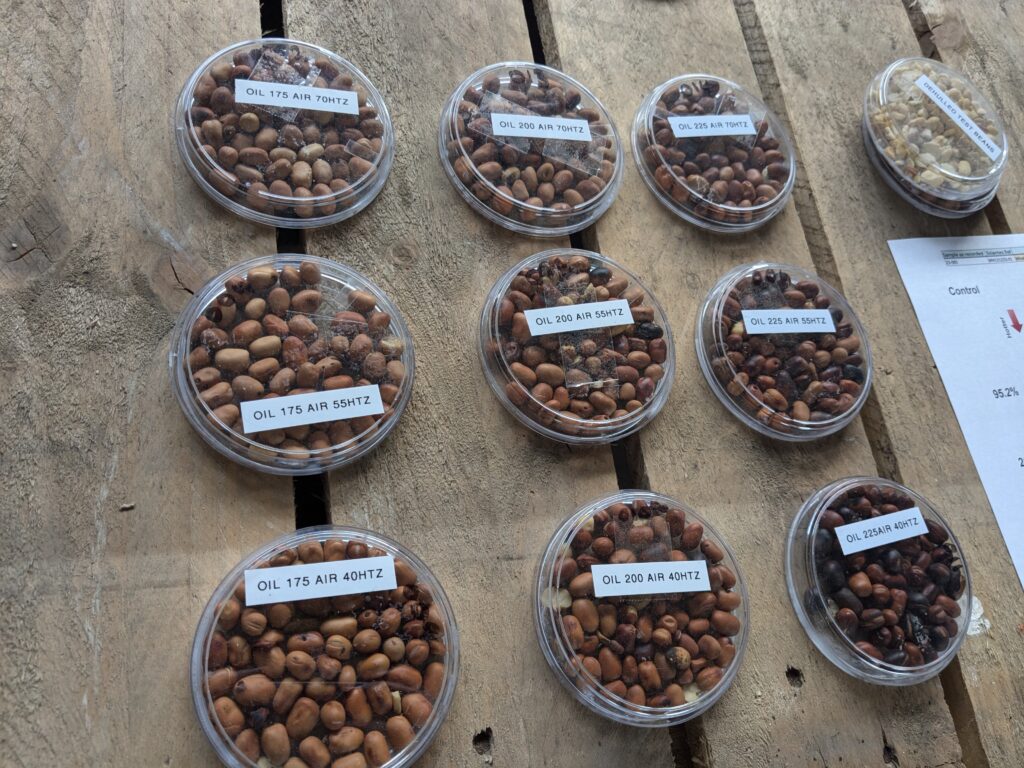
“We’ve been testing two toasting machines – one electric and one oil powered – and evaluating the nutritional composition of beans roasted at different temperatures and for different lengths of time.”
Both Mecmar manufactured machines produce similar results, but initial work suggests the electric version might be most suitable for on-farm toasting. “If farmers can process the beans themselves, it would really build the case that faba beans can provide a viable replacement for soya.”
Protein quality
Toasting beans improves the quality of the protein, explains nutritionist and consultant Andy King who has been working on the project with another partner, First Milk.
Andy says: “Protein quality is particularly important for high yielding dairy cows in early lactation as they need protein to reach the hind gut and not be degraded in the rumen first.”
Density of protein is also important, he adds. “A benefit of faba beans is that they also provide a good starch component to the diet which means we can take out cereals or maize to make more space for beans.”
This autumn First Milk is embarking on feeding trials. First Milk’s Regenerative Programme Manager Roger Briddock explains that the processor ran a preliminary trial with one farm in 2023, which was a midway through its autumn calving block when it started. The plan now is to step that up to 10 farms representing different systems for 2024-5.
“In the first trial we replaced soya gradually with faba beans. It all went to plan, and our results showed that the cows performed just as well after replacing the soya with beans and adjusting the ration,” explains Roger.

In this first trial fresh beans were crushed and added to the herd’s total mixed ration (TMR), but the 2024-5 trials will evaluate other feeding systems and introduce toasted beans.
Andrew says: “Part of my role is developing a grid to identify where the yield break point is for toasted versus non-toasted beans so we can see where we can use fresh beans whilst maintaining cow performance and health.”
Processing costs
This will be particularly useful given the current low availability of toasted beans and the added cost due to the additional processing, he added.
“Overall, the most difficult part of using beans in the dairy cow diet is lack of availability,” adds Andrew. “We just don’t have the home-grown supply at the moment, which is one reason why this project is so important. We need arable farmers to see that there is an opportunity here.”
Roger explains that First Milk will be looking to run the trial on 8-10 farms over two years. “We will choose the farms carefully. Participants need to have meticulous and consistent management and be committed to the aims.”
First Milk will take silage analyses before any changes are made to the diet and will need access to the herd’s milk recording and metabolic testing data so that any changes from the changes can be scrutinised.
The beans will be sourced within the project where possible and (as with the ‘Pulse Pioneer’ growers) participants will take carbon baselines of their unit before and after with Farm Carbon Toolkit.
Roger adds: “Being part of the NCS project is really important to us. We always seek holistic solutions that are aligned with our regenerative ethos. Accredited deforestation free soya is only a partial solution to ensuring dairy cow diets are more sustainable.
Regenerative farming
Our strategy is to focus on more milk from forage and hence reduce the need for supplementary feeds, whilst ensuring that those feeds are grown regeneratively and wherever possible from UK farms.
“A joined-up supply-chain approach to the current irregularity of the demand for and supply of UK beans could provide a win-win for arable and dairy farmers alike.”
The farmers who take part will be invited to farm visits and meetings and will have full support from the processor. They will also be encouraged to discuss their experiences with each other and outcomes will be shared far and wide, he concludes.
“We won’t be keeping this information to ourselves, we want it to benefit the wider industry. Our belief is that cow performance can be maintained, whilst improving the sustainability and transparency of feed purchased for milk production.”
Visit ncsproject.co.uk