
How Yattendon Estate is Boosting Confidence and Crop Performance
For Pulse Pioneer, Nick Down, Yattendon Estate‘s Farm Manager, beans aren’t just a break crop, they’re a way to connect soils, markets, biodiversity, and business resilience.
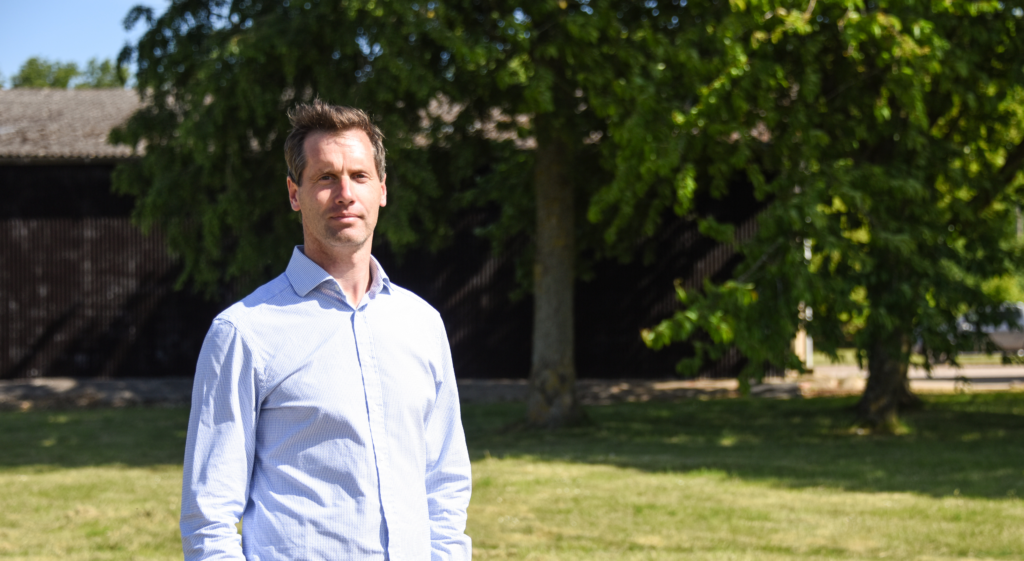
It’s a mindset rooted in Integrated Farm Management (IFM) – a practical, whole-farm approach that supports thoughtful decision-making, continuous learning and improvement, and responsible use of natural resources. It underpins both Nick’s day-to-day management and Yattendon’s commitment as a LEAF Demonstration Farm, sharing good practice and fostering open, honest discussion across the industry.
This approach has guided Yattendon’s journey over the years – analysing field performance, matching land use to its strengths, and building a more resilient, climate-smart rotation for the future.
A diverse estate, shaped by resilience
The 2,200-hectare Berkshire estate combines 1,750 ha of arable land with permanent pasture and commercially managed forestry. Farming decisions balance productive ambition with environmental stewardship, supported by Countryside Stewardship and SFI agreements on land better suited to nature recovery than production.
Soils vary widely across the estate, from calcareous silts to heavy, flinty clay loams, which makes crop placement and flexibility essential. Partnerships with local graziers help manage herbal leys, while forestry, retail and local brewing enterprises contribute to a diverse and resilient business model. Collaboration with colleagues, partners, and the local community remains central to every decision.
IFM in practice means more than just managing land well, it’s about organisation and planning, engaging people, and strengthening the landscape as a whole. Yattendon demonstrates IFM at scale: working with the land’s assets and integrating them into a wider, joined-up system.

Why beans and why the Nitrogen Climate Smart (NCS) Project?
With the challenges around oilseed rape previously standing alone as the break crop, Nick wanted to diversify while reducing reliance on fertiliser and plant protection products. Winter beans offered a route to improved soil structure, nitrogen fixation, reduced synthetic inputs, and new market opportunities.
“I’ve always had a thirst for knowledge and for improving what we do. NCS gives us the chance to benchmark beans properly, and to learn from growers we’d never normally be compared with.” says Nick.
As a Pulse Pioneer in the project, Nick now benefits from:
- Detailed bean-specific benchmarking
- Access to specialist agronomy and crop health expertise
- Reliable data-sharing and technical support
- Peer-to-peer learning – which he rates as the most valuable part of the programme.
Together, these elements provide confidence in treating beans not as a rotational compromise, but as a crop with genuine strategic potential. It’s helping growers approach beans with ambition, not hesitation and providing the evidence to support better decisions.
Learning from real-world variation
Yattendon’s NCS trial splits one field between winter beans and legume fallow, monitoring differences in rotational and legacy benefits, particularly on the following wheat crop. The first year brought challenges: a delayed drilling window and severe summer drought halved yields compared to their five-year average, and the legume fallow had lower competitiveness against blackgrass. But for Nick highlights that “the greatest value” from the trial is “hearing what others are trying and from knowing what’s working and what isn’t”. Learning remains the win, reinforcing the importance of farmer-led knowledge exchange.
Knowledge exchange across the NCS Project, through events, data-sharing and open discussion, offers reassurance that pulses can be productive and marketable.
Yattendon grows for human consumption first, with value-added feed routes available when quality specifications aren’t met. With tight cost control, including cleaning home-saved seed, beans already enhance rotation performance, even in tougher seasons.
Advice for growers thinking about pulses
Nick is honest about what beans (and the British weather) can throw at you. His advice:
- Know your costs – not just averages but crop-by-crop, field-by-field, year-by-year.
- Be realistic – plan for poor seasons as well as the good ones.
- Be bold and act decisively – both when something works and when it doesn’t
- Play the long game – focus on rotational value, not just benefits you can sell by the tonne.
“The challenges keep changing, and they don’t get any easier, but our ability to navigate them can improve” Says Nick.
Looking ahead
With first-year data due shortly, Nick is eager to understand the nitrogen legacy gains in the following wheat crop, and to build evidence across multiple seasons. He continues to pursue targeted input reduction, including trialling BYDV-tolerant varieties and reducing insecticide use. For Yattendon, beans are not a stop-gap. They are an investment in resilience, supported by evidence, guided by IFM, and enabled by the NCS project.