Project driving increase in home-grown pulses first to benefit from new ADAS platform
Farmers who are part of an ambitious project to grow more pulses and cut carbon emissions from UK agriculture will be the first to benefit from a new knowledge exchange platform launched today by ADAS.
The independent agricultural consultancy has created the PulsePEP (Performance Enhancement Platform) where trial results, data and supporting information from experts involved in the Nitrogen Climate Smart (NCS) project will be hosted.
Launched today at The CropTec Show, the aim for the online tool is to bring together a community united behind the aims of the NCS initiative.
“The PulsePEP has been designed with farmers in mind – by sharing knowledge the PulsePEP will ensure we can produce pulse crops that are profitable and resilient, so that farmers will want to grow them,” said Dr Thomas Wilkinson, Senior Research Consultant in Crop Physiology at ADAS.
“Those farmers who are doing on-farm trials for the NCS project will share data that will hopefully demonstrate the benefits of growing pulses in rotations. These trials will implement and build on the latest scientific understanding from research platforms and small-plot trials.”
The NCS project is a four-year £5.9m research programme funded by Defra’s Farming Futures R&D fund, which is delivered by Innovate UK.
More than 200 UK farms will be involved in either trials, carbon baselining, or sharing information, while 17 industry partners will also be contributing their expertise. All of this knowledge will come together on PulsePEP, with the overall goal being to bring about a reduction of 1.5Mt CO₂e per annum.
With the PulsePEP tool now live, the next stage of the project is to carbon baseline the farms involved. Tailored assistance will be provided by the Farm Carbon Toolkit (FCT), allowing GHG emissions to be tracked throughout the project.
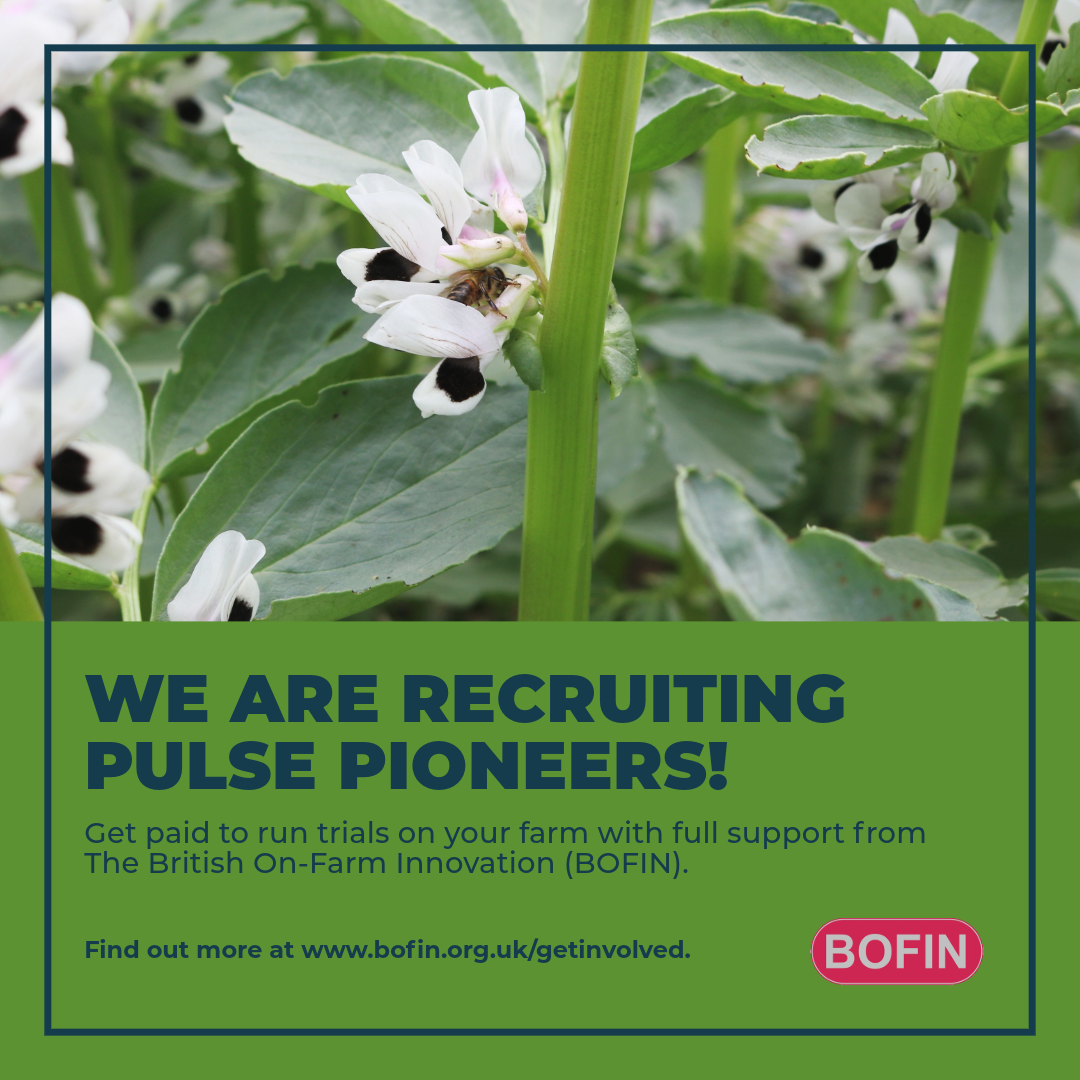
Some of the farms will be appointed as ‘Pulse Pioneers’ and will be paid to carry out trials. These will involve novel concepts, ideas, products, rations and sensors designed to help farmers reduce GHG emissions. This will be administered by the British On-farm Innovation Network (BOFIN).
The PulsePEP is part of the wider FarmPEP digital platform and is specifically designed to focus on pulse topics and provide a specific home for material relating to pulse production.
“The PulsePEP is free to use and anyone can log on to view the content,” Tom continued. “Those hoping to engage more can set up an account and then post content themselves or follow specific topics.
“Research from, and identified by, the NCS project partners will also be accessible, fulfilling the project’s aim to connect and link to a range of useful content associated with pulse growth. We highlight content to ensure it can be trusted and to help bring the most authoritative response to any queries raised.”
Nitrogen Efficient Plants for Climate Smart Arable Cropping Systems (NCS) is a four-year £5.9M research programme involving 200 UK farms and 17 partners.
The project aims to bring about a reduction of 1.5Mt CO₂e per annum or 54% of the maximum potential for UK agriculture through increasing pulse and legume cropping in arable rotations to 20% across the UK and replacing 50% of imported soya meal used in livestock feed rations with home-grown pulses and legumes.
The project is steered by science and proven by real farm enterprises, with significant benefits for both crop and livestock productivity, including cost savings of over £1bn/yr.
PGRO (Processors and Growers Research Organisation) leads the consortium that includes AB Agri, ADAS, Agrii, BOFIN (British On-Farm Innovation Network), Cranfield University, Farm Carbon Toolkit, Firstmilk, GWCT (Game and Wildlife Conservation Trust), The James Hutton Institute, Kelvin Cave, LC Beef Nutrition, LEAF (Linking Environment And Farming), McArthur Agriculture, PBL Technology, SRUC and Wessex Water.
The NCS Project is funded by the Farming Futures R&D Fund: Climate smart farming, part of Defra’s Farming Innovation Programme. Defra are working in partnership with Innovate UK who are delivering the programme. Project number: 10043778
Innovate UK is the UK’s national innovation agency. It supports business-led innovation in all sectors, technologies and UK regions, helping businesses grow through the development and commercialisation of new products, processes, and services. ukri.org
Farmers are encouraged to join the PulsePEP community, a platform and knowledge exchange hub. For more, visit ncsproject.co.uk
A selection of high-resolution pictures, including photos of key project representatives, general shots of pulse and legume crops and logos can be found here.
All press enquiries for NCS should be directed to BOFIN Farmers info@bofin.org.uk, or contact Skye Melita (skye@bofin.org.uk, 07483 238577)
First ‘pulse pioneers’ recruited to farmer-led research project
UK pea and bean growers are being invited to become ‘pulse pioneers’ and be paid to carry out on-farm trials which contribute to a ground-breaking research programme.
The Nitrogen Climate Smart (NCS) Project aims to facilitate the increase of pulse cropping from 5% to 20% in arable rotations, and displace up to half the imported soya meal used in livestock feed rations.
At least 40 farmers will be recruited and the first contracts to conduct the work have been signed this week.
Tom Allen-Stevens, founder of the British On-Farm Innovation Network (BOFIN), is leading the farm trials work.
“We are looking for farmers who are growing, or plan to grow, beans or peas this season and who are growing them in the rotation for the next four years,” he said.
“We will offer support and payment for them to monitor the crop. In particular we want to compare an area grown to pulses with one that isn’t over a period of four years. This rotational platform approach will enable us to monitor the benefits of pulse crops through the rotation.”
One of the first farmers to commit to becoming a pulse pioneer is Will Oliver of Osbaston House farm, Leicestershire.
Will is an award-winning mixed arable and poultry farmer with a 200,000-bird broiler coupled with 850ha of arable land which is put to winter wheat, maize, winter beans and permanent pasture countryside stewardship. Sheep also graze some parts of the farm.
“Pulses are really important to us because we’re not growing oilseed rape anymore,” Will says. “They’re our break crop with an early entry – in most years – and good for the ground as well.
“They provide a nitrogen and organic matter boost. Just having to use less bagged fertiliser in general is a positive.”
Will first heard about the NCS Project in late 2023 and decided he was interested in being part of some work to improve the understanding of the potential beans have in UK agriculture.
“I just think beans have never really had as much research into them as they deserve,” he said. “Maybe if we can fine tune how we grow them a bit, tweak varieties perhaps, we might be able to get a bit more out of them.”
His winter beans usually return between three and four tonnes per hectare with an average of 4.2t/ha in 2023. But for Will it’s not all about yield.
“People tend to call profit what you actually get in your bank at the end,” he said. “But then you can say, right, our soils are in good condition, and we’re saving a pass on our wheat establishment.
“So sometimes you’ve just got to look away from the money side of things and see what else it brings to the rotation, especially in this current climate.”
The exact details of what he wants to trial for the NCS Project are yet to be set in stone.
He said: “I’m still looking at options but I’d like to include a trial I’m planning of QLF boost (a liquid carbon-based fertiliser). I will probably do tramline trials spreading a molasses product. We’ve had quite good results with maize and wheat, so it’d be interesting to see where beans come in on that.
“I’m just interested in how we can grow a crop better and be a bit more efficient, and the monitoring I’ll be doing as a pulse pioneer will help understanding.”
Pea and bean crops put forward by pulse pioneers will be entered into the ADAS Pulse YEN which gives growers detailed feedback on how the crop has performed through the season, as well as an analysis of yield.
The NCS Project has a set of seismic objectives which, if achieved, would transform UK arable rotations while making an enormous contribution towards UK agriculture’s carbon-cutting targets.
Reducing emissions by 1.5Mt CO₂e per annum (or 54% of the maximum potential for UK agriculture) is the primary goal which could be achieved by replacing half the imported soya used in livestock feeding rations with home-grown pulses. The project aims to prove this can be achieved by working closely with over 200 farmers.
Led by PGRO, the £5.9m Innovate UK-funded project launched in June 2023 hinges on the consortium of 18 partners and the network of farmers who will carry out trials.
To become involved in the project go to www.ncsproject.co.uk and to listen to Will and Tom talk about the NCS Project in more detail, download the latest episode of the PGRO’s Inside The Pod podcast.
ENDS
Notes to editors
Nitrogen Efficient Plants for Climate Smart Arable Cropping Systems (NCS) is a four-year £5.9M research programme involving 200 UK farms and 17 partners.
The project aims to bring about a reduction of 1.5Mt CO₂e per annum or 54% of the maximum potential for UK agriculture through increasing pulse and legume cropping in arable rotations to 20% across the UK and replacing 50% of imported soya meal used in livestock feed rations with home-grown pulses and legumes.
The project is steered by science and proven by real farm enterprises, with significant benefits for both crop and livestock productivity, including cost savings of over £1bn/yr.
PGRO (Processors and Growers Research Organisation) leads the consortium that includes AB Agri, ADAS, Agrii, BOFIN (British On-Farm Innovation Network), Cranfield University, Farm Carbon Toolkit, Firstmilk, GWCT (Game and Wildlife Conservation Trust), The James Hutton Institute, Kelvin Cave, LC Beef Nutrition, LEAF (Linking Environment And Farming), McArthur Agriculture, PBL Technology, SRUC and Wessex Water.
The NCS Project is funded by the Farming Futures R&D Fund: Climate smart farming, part of Defra’s Farming Innovation Programme. Defra are working in partnership with Innovate UK who are delivering the programme. Project number: 10043778
Innovate UK is the UK’s national innovation agency. It supports business-led innovation in all sectors, technologies and UK regions, helping businesses grow through the development and commercialisation of new products, processes, and services. ukri.org
Farmers are encouraged to join the PulsePEP community, a platform and knowledge exchange hub. For more, visit ncsproject.co.uk
A selection of high-resolution pictures, including photos of key project representatives, general shots of pulse and legume crops and logos can be found here.
All press enquiries for NCS should be directed to BOFIN Farmers info@bofin.org.uk, or contact Skye Melita (skye@bofin.org.uk, 07483 238577)
£5.9M Defra-funded pulse project launched to cut farm emissions
A new industry-leading project has been launched to help farmers reduce agricultural emissions by 1.5Mt CO₂e a year.
‘Nitrogen Efficient Plants for Climate Smart Arable Cropping Systems’ (NCS) is a four-year £5.9M ambitious research project involving 200 UK farms and 17 industry partners. Funded by Defra’s Farming Innovation Programme, delivered by Innovate UK, the project is one of the ‘cutting-edge’ farming projects receiving a share of £30M of government funding, announced last month (31 May).
The consortium of UK companies, research institutes and farmer networks, led by PGRO, aims to bring about a reduction of 1.5Mt CO₂e per annum or 54% of the maximum potential for UK Agriculture.
Project aims
The bold, twin aims of the project are firstly to increase pulse cropping in arable rotations to 20% across the UK (currently 5%), and also to develop and test new feed rations. This will help livestock farmers with the project’s second aim, to substitute up to 50% of imported soya meal used in feed with more climate-friendly home-grown pulses and legumes.
These ambitions will be steered by science, but proven by farmers, through a series of paid-for on-farm trials.
“Everyone knows that pulses and legumes have considerable benefits for UK farming systems,” says PGRO Chief Executive, Roger Vickers, who leads the NCS consortium. “But these have never been truly and accurately measured. So their value has been sorely underplayed and their potential to address the climate crisis has gone unrecognised.
“Together we can change that. We now have the science, the tools and the know-how among UK farmers, not only to tap into that potential, but to develop it further. Bringing that talent together is what lies at the heart of NCS – it’s never been done before, and there’s never been a project on this scale with this much ambition.”
Pulse Pioneers
The first stage of the project will give 200 UK farmers direct support to establish their business’ carbon baseline, using the Farm Carbon Toolkit. The GHG emissions from these farms will then be tracked throughout the project and will form a fundamental part of the dataset.
The leading innovators among them will then be paid to work with scientists to co-design crop and feeding trials to carry out on their farms.
These ‘Pulse Pioneers’ will explore ways and means for soils to thrive, crop yields to build and livestock productivity to flourish, through better use and marketing of home-grown pulses and legumes.
The on-farm progress will be based on cutting-edge technologies and farming systems, incorporating some of the latest research and innovations from leading UK institutes and tech companies. These will be underpinned by a rigorous use of data, including the UK’s first ever full lifecycle analysis of cropping rotations and livestock systems.
How to get involved
Keen to expand the knowledge exchange beyond this core group of farmers, the project is also launching the PulsePEP (Performance Enhancing Platform), led by ADAS. This will be a hub for the farmer-led community striving to achieve the best from pulse crops and reduce carbon emissions, as well as a place for discussion on best-practice pulse cropping.
The project team are urging farmers interested in being involved – or those who just have a passion for pulses – to sign up now.
“This will be the defining project of our time,” believes Mr Vickers. “It’s not just the chance for UK Agriculture to make a seismic shift towards Net Zero, but it’ll also deliver a prosperous and resilient way of farming for communities worldwide.
“We want farmers to join us and be part of this exciting journey of discovery. You will shape it. Your knowledge and experience will enrich the science we’re bringing together. You will inspire others and accelerate the pace of change. And together we’ll achieve a farming future that is richly rewarding and immensely gratifying.”
The project was officially launched at this year’s Cereals Event (13-14 June), with more than 250 members already signed up to the PulsePEP – with over 100 of these farmers who wish to have their carbon baselined a part of the project. More information about the project, including links to project partners and research initiatives that underpin the project can be found at ncsproject.co.uk
[BOX]
HEAD: The figures – explained
The annual reduction in CO₂ equivalent emissions can be achieved through:
Increasing pulse and legume cropping areas to the rotational optimum of 20% (1M ha) across UK farms. This would reduce nitrogen fertiliser use by 233,000t, resulting in 0.55M tonnes CO₂e reduction.
Using the subsequent produce in animal feed, replacing 50% of imported soya meal and delivering a further 0.7M tonnes CO₂e reduction.
The residual nitrogen benefit to following crops through soil enrichment, leading to an additional 0.25M tonnes CO₂e reduction.
ENDS
Notes to editors
Nitrogen Efficient Plants for Climate Smart Arable Cropping Systems (NCS) is a four-year £5.9M research programme involving 200 UK farms and 17 partners.
The project aims to bring about a reduction of 1.5Mt CO₂e per annum or 54% of the maximum potential for UK agriculture through increasing pulse and legume cropping in arable rotations to 20% across the UK and replacing 50% of imported soya meal used in livestock feed rations with home-grown pulses and legumes.
The project is steered by science and proven by real farm enterprises, with significant benefits for both crop and livestock productivity, including cost savings of over £1bn/yr.
PGRO (Processors and Growers Research Organisation) leads the consortium that includes AB Agri, ADAS, Agrii, BOFIN (British On-Farm Innovation Network), Cranfield University, Farm Carbon Toolkit, Firstmilk, GWCT (Game and Wildlife Conservation Trust), The James Hutton Institute, Kelvin Cave, LC Beef Nutrition, LEAF (Linking Environment And Farming), McArthur Agriculture, PBL Technology, SRUC and Wessex Water.
The NCS Project is funded by the Farming Futures R&D Fund: Climate smart farming, part of Defra’s Farming Innovation Programme. Defra are working in partnership with Innovate UK who are delivering the programme. Project number: 10043778
Innovate UK is the UK’s national innovation agency. It supports business-led innovation in all sectors, technologies and UK regions, helping businesses grow through the development and commercialisation of new products, processes, and services. ukri.org
Farmers are encouraged to join the PulsePEP community, a platform and knowledge exchange hub. For more, visit ncsproject.co.uk
A selection of high-resolution pictures, including photos of key project representatives, general shots of pulse and legume crops and logos can be found here.